Price terms as published
Each line is the vendor’s own wording, split from the price capture checked on 2026-10-14. Nothing here is rounded, converted or re-worded — the full sentences stay in the review below. Lines that carry only a price continue the plan named on the line above, in the vendor’s own order.
| # | Plan / term | Checked |
|---|---|---|
| 1 | Free (open source, non-commercial only) | 2026-10-14 |
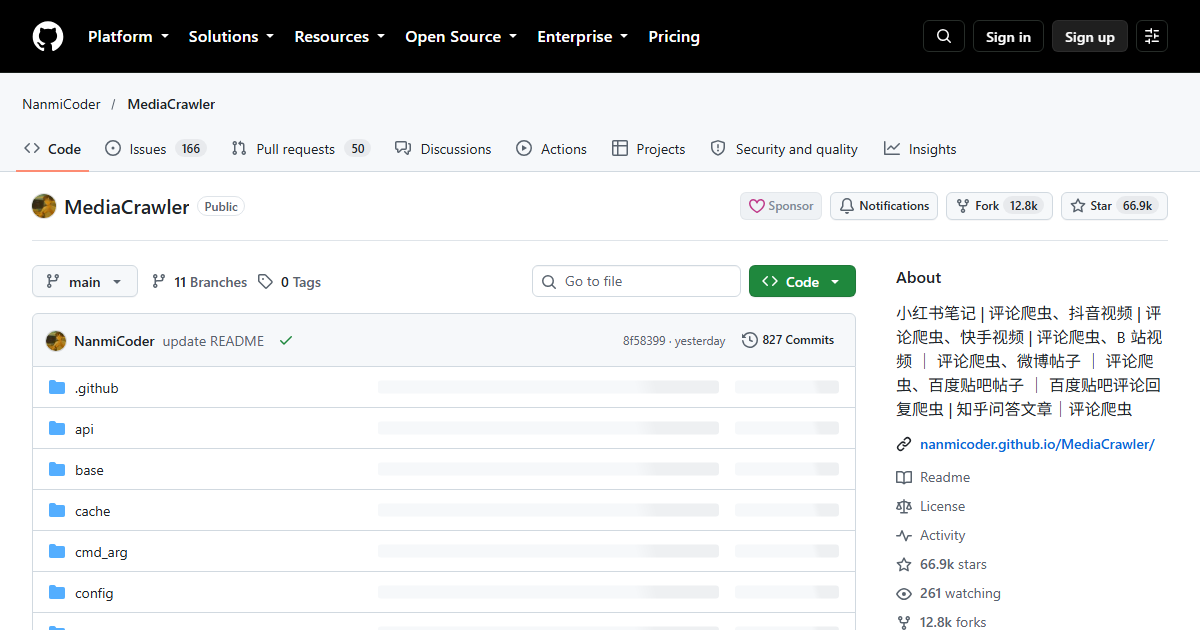
One-liner: MediaCrawler is a Python toolkit that logs into and crawls China’s seven major social platforms — Xiaohongshu (RedNote), Douyin, Bilibili, Weibo, Zhihu, Tieba, and Kuaishou — collecting posts, comments, and user data through a single CLI.
Verified facts (checked 2026-09-02; repo stats re-read 2026-10-14)
| Attribute | Value | Source |
|---|---|---|
| GitHub stars | 66,811 | NanmiCoder/MediaCrawler via GitHub API, 2026-10-14 |
| Forks | 12,785 | GitHub API, 2026-10-14 |
| License | Non-Commercial Learning License 1.1 | LICENSE file, read directly |
| Last push | 2026-10-10 | GitHub API, 2026-10-14 |
| Created | June 2023 | GitHub API |
| Platforms | 7 (XHS, Douyin, Bilibili, Weibo, Zhihu, Tieba, Kuaishou) | README |
How it works
You launch it with a platform flag and scan a login QR code with your phone — it drives a real browser session, so it reads data behind login walls that plain HTTP scrapers can’t touch:
uv run main.py --platform xhs --lt qrcode --type searchWe verified the documented install and run commands (including its FastAPI WebUI) against the repository — they are real, which is rarer than it sounds in this category.
The catch nobody in Chinese-language coverage leads with
The project’s homepage, install docs, and GitHub description are unusually honest that this license exists — but most viral write-ups about MediaCrawler present it as a monetizable data-collection tool. It isn’t one. The Non-Commercial Learning License 1.1 permits study and research; using scraped output for commercial purposes (marketing research sold to clients, training data for a paid product, competitive intelligence) is outside what the license grants. A capable tool and a blocked use case can both be true at once.
For commercial needs, the practical options are platforms’ official APIs, licensed data vendors, or permissively-licensed scrapers for sites whose terms allow it.
Who should actually use it
Academic researchers of Chinese social media, journalists, and individual builders doing personal, non-commercial analysis. It remains the most complete open implementation of its kind — six years of iteration, a large issue tracker, and genuinely transparent documentation.
Repository stats and license text verified against primary sources on 2026-09-02, with repo stats re-read on 2026-10-14. This entry follows our verification policy: we read the LICENSE file itself, not third-party summaries of it.
Repository facts (GitHub API + raw README, checked 2026-10-16)
| Attribute | Value |
|---|---|
| Stars / forks | 66,956 / 12,809 |
| Open issues | 216 |
| Licence (GitHub API) | NOASSERTION — the README links a LICENSE file but GitHub does not classify it as a standard SPDX licence, so read the file itself |
| Primary language | Python |
| Repository created | 2023-06-09 |
| Last push | 2026-10-15 |
| Archived | No |
| Homepage | nanmicoder.github.io/MediaCrawler/ |
Three years of history and 67k stars, with a push on 2026-10-15 — this is one of the longest-lived repositories in this category.
Scope, as the project states it
The README (in Chinese, with English, Spanish and other translations available) describes a multi-platform scraper for public information: Xiaohongshu (notes), Douyin, Kuaishou, Bilibili, Weibo, Baidu Tieba and Zhihu — keyword search, a specific post ID, second-level comments, and creator homepages are the capabilities its feature table lists per platform.
The technical approach, in the project’s own words
- Core: Playwright browser automation to keep a logged-in session.
- No JS reverse engineering: instead of breaking platform encryption, it reads the signature parameters through JS expressions inside a browser context that already holds the login state.
- Stated advantage: a much lower technical barrier than reversing signature algorithms.
That design is also the honest risk disclosure: your own account session is the credential. Automation against a platform’s terms of service using your account can get that account restricted, which is the practical failure mode here — not detection of the scraper itself.
The disclaimer the README puts at the top
The project leads with a warning: use it for learning purposes only, links to a public list of crawler-related legal cases in China, states that commercial use is prohibited, that the content must not be used for illegal purposes or to infringe others’ rights, and that the authors accept no responsibility for how the repository is used. A README this explicit is not decoration — it tells you the maintainers know exactly how the tool can be misused, and that you are on your own if you cross that line.
Installation routes (README’s quick start)
uv (recommended), Node.js, or the Python package — three routes, with uv presented
first. The README also carries a paid placement (a sponsor block for a browser-automation service),
which is worth knowing about when you read the surrounding claims.
What to check before using it
- Licence uncertainty. GitHub does not classify the licence; for anything beyond personal
experimentation, read
LICENSEand the disclaimer before you redistribute or build on it. - Platform terms and local law. Public data does not mean unrestricted collection; the README’s own disclaimer and its linked case list are the shortest path to understanding the exposure in the project’s home jurisdiction.
- Maintenance surface. Seven platforms with login-based sessions break whenever any of them changes its flow — 216 open issues is where you look first for current breakage.
Source note: repository statistics come from the GitHub API; the platform list, technical approach, disclaimer summary, installation routes and sponsor note come from the raw README read on 2026-10-16. No crawler was run for this entry.