Price terms as published
Each line is the vendor’s own wording, split from the price capture checked on 2026-09-21. Nothing here is rounded, converted or re-worded — the full sentences stay in the review below. Lines that carry only a price continue the plan named on the line above, in the vendor’s own order.
| # | Plan / term | Checked |
|---|---|---|
| 1 | Free (open source, MIT) | 2026-09-21 |
One-liner: A Chinese-patent workflow packaged as a standards-compliant agent-skill bundle: drop in design docs and code, and the skills mine patentable points, run prior-art checks, and produce disclosure drafts and application documents — diagrams included.
Verified facts (as of 2026-09-21)
| Attribute | Value | Source |
|---|---|---|
| GitHub stars | 10,048 | repo page snapshot, 2026-09-21 |
| Forks | 1,042 | repo page snapshot |
| License | MIT (LICENSE file read directly) | repo license field + raw LICENSE |
| Last commit | 2026-09-20 | commits feed |
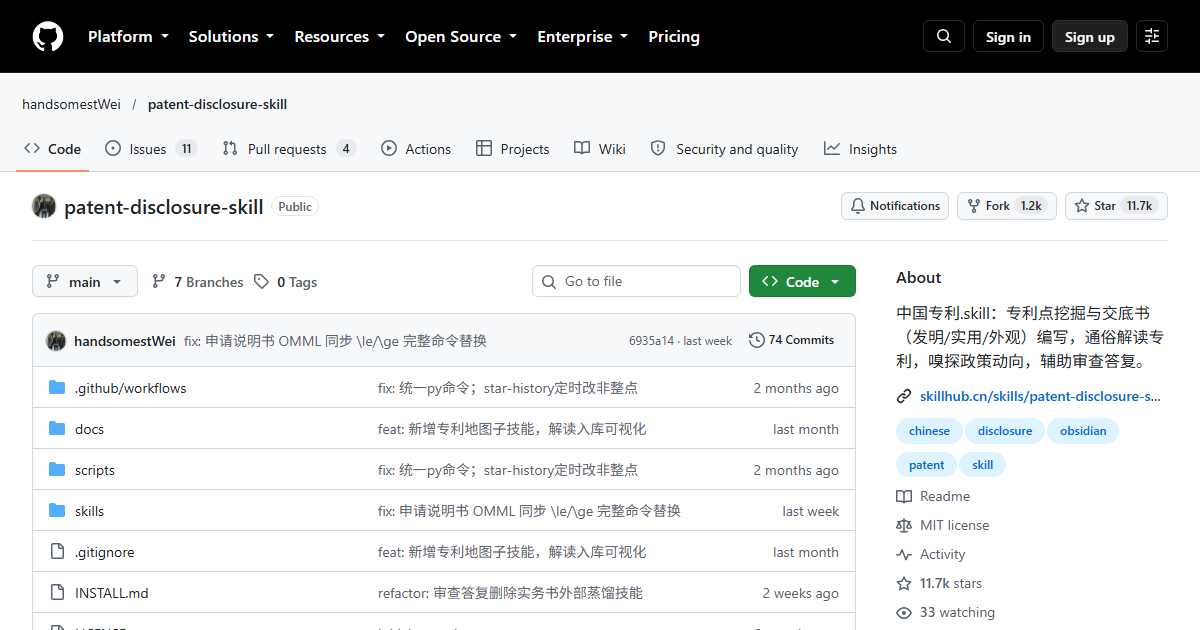
| Repo description | “中国专利.skill”: patent-point mining and disclosure drafting (invention / utility model / design), plain-language patent reading, policy tracking, examination-reply assistance | repo page description |
| Standard | Built on the AgentSkills standard (agentskills.io), with SKILL.md entry points | README badges |
| Runtime hints | Python 3.9+, Playwright (Mermaid rendering + CNIPA site automation) | README badges |
| Sub-skills (README list) | patent-disclosure (交底书), patent-application (申请文件), patent-reader, patent-search, patent-oa, patent-map, patent-exam-policy, patent-docket | README sub-skill table |
What the sub-skills cover
The README groups the pack into drafting, reading, and prosecution work.
patent-disclosure takes project materials (design docs, code) and produces
an editable disclosure with structure diagrams (Mermaid) and Word output,
including a 1+N filing-layout strategy after the first draft; patent-application
converts a disclosure into claims, specification, abstract, and drawings;
patent-search / patent-oa / patent-exam-policy cover prior-art lookups,
office-action replies, and CNIPA policy reading; patent-reader turns
individual published patents into plain-language notes in an Obsidian vault,
and patent-map builds citation-network and technology-effect visual maps on
top of that base.
The catches
- Jurisdiction-specific. The workflows, terminology, and site automation target CNIPA practice. For US/EPO filings you get the pattern, not the paperwork.
- Playwright scraping of official sites breaks. Anything that drives the CNIPA public-announcement site inherits its downtime, CAPTCHAs, and layout changes; treat those skills as best-effort.
- It drafts, it does not decide. Patentability, claim scope, and filing strategy remain attorney judgment; output should be reviewed before any submission.
Who should use it
R&D engineers and inventors (or their technical writers) who have the design documentation but not the patent-prose skill, especially in Chinese-language CNIPA practice; agent-skill authors looking for a serious, high-star example of domain-specific skill packaging.
Stats, license file, sub-skill list, and toolchain claims verified against primary sources (GitHub repo page, raw README/LICENSE, commits feed) on 2026-09-21. Official-sources-only: no disclosure was drafted with it here.
Repository facts (GitHub API + raw README, checked 2026-10-16)
| Attribute | Value |
|---|---|
| Stars / forks | 11,709 / 1,236 |
| Open issues | 15 |
| Licence | MIT |
| Primary language | Python |
| Repository created | 2026-04-07 |
| Last push | 2026-10-16 |
| Archived | No |
| Linked homepage | skillhub.cn/skills/patent-disclosure-skill |
| Topics | chinese, disclosure, obsidian, patent, skill |
The repository description is written in Chinese and translates to: “China patents .skill: mining
patentable points and writing disclosure documents (invention / utility model / design), plain-language
patent explanations, policy-trend sniffing, and help with examination replies.” The README itself is
Chinese-language — the badges show Python and Playwright, and it links INSTALL.md, SKILL.md and
agentskills.io, so it ships as an agent-skill bundle rather than a standalone app.
What the README says the skill does
The heading list is the honest scope: patent disclosure drafting, plain-language patent reading, a sub-skill list, and a policy/examination layer. Concretely, per the README’s own summary: mine patentable points from project material, run novelty searches (including by drawing or by claim), write invention/utility-model/design disclosures with diagrams, produce an editable Word file, and keep a revision trail across multiple rounds of added material and corrections.
The stated motivation is worth quoting because it explains the design: “After years of core R&D,
my name never appeared in the inventor field” — the author frames the skill as closing the gap
between doing the work and being able to file it. The output model follows from that: timestamped
draft files under an outputs directory, a mermaid diagram set, and a conversation log for each
revision, so the drafting history is auditable.
The Obsidian layer (and why it matters)
The second half of the README is about turning single readings into a private patent knowledge base: each patent is read into plain-language notes plus a graph, imported into Obsidian, and cross-linked, so claims, terminology, clues and drawings interconnect. The README goes on to describe family comparisons, technology-route mapping and difference scanning on top of that accumulated library, and mentions Obsidian CLI for scripted retrieval.
Two practical consequences for a reader: the value compounds only if you feed it consistently, and it puts patent text into a local vault — check where that vault lives, what is synced and who else can read it, especially if the material is pre-filing.
What to verify before relying on it
- Search completeness is not something a skill can promise. Novelty checking here appears to run through Playwright against patent sites; confirm which databases it reaches from your network and treat the result as a first pass, not a freedom-to-operate opinion.
- Language coverage. The skill, the README and the flow are Chinese-first; an English-language portfolio may need prompting changes rather than just translation.
- 15 open issues and a single maintainer is a small support surface for a workflow that ends up in a legal filing.
Source note: repository statistics come from the GitHub API; scope, motivation quotes, output description and the Obsidian workflow come from the raw Chinese README, both read 2026-10-16. No patent material was processed for this entry.