Price terms as published
Each line is the vendor’s own wording, split from the price capture checked on 2026-09-22. Nothing here is rounded, converted or re-worded — the full sentences stay in the review below. Lines that carry only a price continue the plan named on the line above, in the vendor’s own order.
| # | Plan / term | Checked |
|---|---|---|
| 1 | Free (open source, MIT) | 2026-09-22 |
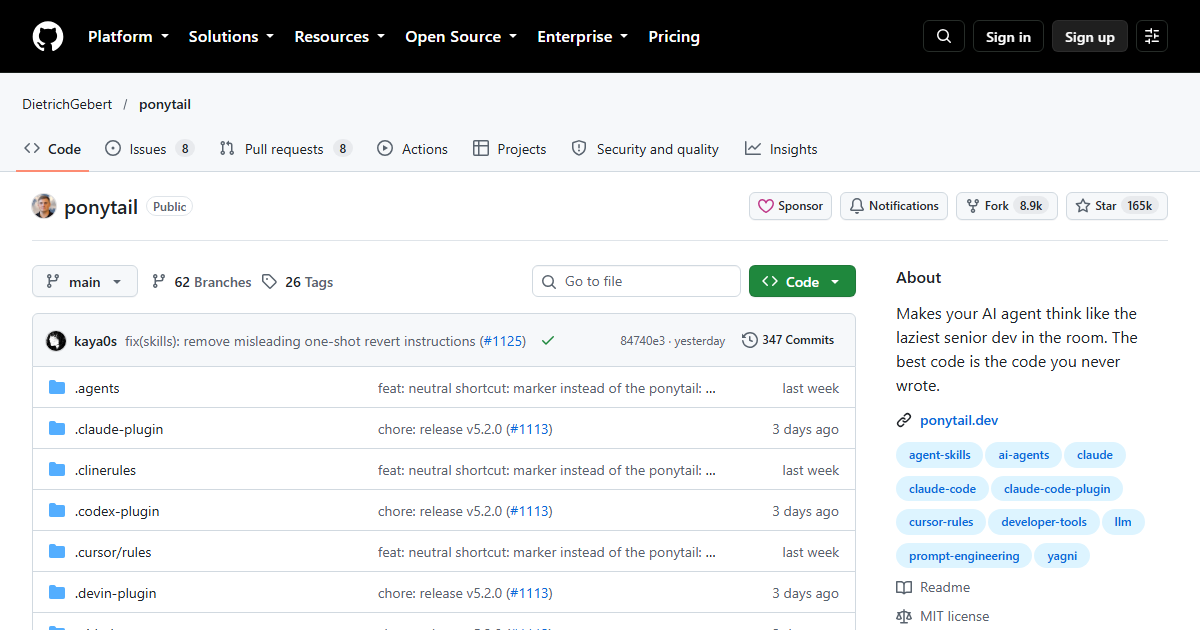
One-liner: Ponytail is an agent skill built on one maxim — “The best code is the code you never wrote” — that makes your AI coding agent argue for deletion, reuse, and simplicity before it lets itself add anything.
Verified facts (GitHub API + raw README, 2026-09-22)
| Attribute | Value | Source |
|---|---|---|
| GitHub stars | 143,613 (7,690 forks, 293 open issues+PRs) | DietrichGebert/ponytail via GitHub API, 2026-09-22 |
| License | MIT | GitHub API license field |
| Language | JavaScript | GitHub API |
| Created | 2026-06-12 | GitHub API |
| Last push | 2026-09-14 | GitHub API |
| Tagline (repo description) | “Makes your AI agent think like the laziest senior dev in the room. The best code is the code you never wrote.” | GitHub API |
| Distribution | npm @dietrichgebert/ponytail |
README badge |
| Agent coverage | badge: “works with 20 agents” | README badge (author count) |
| Hype track record | Trendshift daily/weekly/monthly badges; #1 trending day reported 09-03 | README badges + star-history snapshot (secondary) |
The API figure above is this page’s primary; the 09-17 star-history reading (~141k, global rank #67) is the labeled secondary. Treat any Ponytail number you see by its date.
What “check before build” changes in practice
With the skill active, the agent’s first move on a feature request is a
laziness audit: does this need to exist (delete), does something already do it
(reuse), can it be one line (shrink) — and only then write. It’s the
YAGNI/BNW mindset turned into an instruction file, which is why it lands on
people whose agents have been cheerfully generating 400-line abstractions for
formatDate.
The catches
- Personality skills trade recall for restraint. An agent tuned to “don’t write code” will occasionally talk itself out of code you genuinely wanted — you still own the ask.
- Past the viral peak. Last push 2026-09-14, ~143.6k stars by 09-22: the repo is in maintenance rhythm; the hype is the asset, not a support SLA (293 open issues+PRs).
- 20-agent compatibility is the author’s badge, not a per-agent test suite you can audit.
Who should use it
Anyone whose agent writes more code than the problem deserves. Pair it with a planning skill: Ponytail for restraint, your stack’s conventions for direction.
Repo facts from GitHub API + raw README, 2026-09-22; trending-rank details are labeled secondary snapshots. No agent sessions were run with the skill for this page; no hands-on claims are made.
Repository facts (GitHub API + raw README, checked 2026-10-16)
| Attribute | Value |
|---|---|
| Stars / forks | 164,633 / 8,882 |
| Open issues | 17 |
| Licence | MIT |
| Primary language | JavaScript |
| Repository created | 2026-06-12 |
| Last push | 2026-10-15 |
| Archived | No |
| Linked homepage | ponytail.dev |
| Topics | agent-skills, ai-agents, claude, claude-code, claude-code-plugin, cursor-rules, yagni |
Four months and 164,633 stars. Whatever else that number means, it says the pitch landed with
developers immediately — and the topics (yagni, prompt-engineering, cursor-rules) say the
product is a behavioural rule set for agents, not an application.
What the README claims and shows
The description: “Makes your AI agent think like the laziest senior dev in the room. The best code is
the code you never wrote.” The tagline under the logo is the same idea in nine words: “He says
nothing. He writes one line. It works.” Badges carry the npm package
(@dietrichgebert/ponytail), MIT, a release badge and a “works with 20 agents” badge.
The README is structured as evidence rather than features, in this order: Already built with Ponytail · Numbers · Before / after · The review, rebuilt · The audit, rebuilt · How it works · The prompt · Install · Commands · FAQ · Sponsors · License · Star History.
Two of those sections are the honest core: “The review, rebuilt” and “The audit, rebuilt” compare the same task done with and without the rule set, and “The prompt” publishes the actual instructions the agent receives. A published prompt is a meaningful disclosure: it means you can read what the skill does to your agent’s behaviour before installing it, and edit it if you disagree.
How to read the “Numbers” section
Treat every figure in it as the project’s own, including any line-count or token-savings comparison: they are self-reported, the conditions are chosen by the author, and our entry has not reproduced them. What is worth your time instead is the Install and Commands sections — they tell you whether it is a plugin, a rule file or a CLI wrapper in your setup, and how to remove it again.
What to verify before adopting it
- A published prompt is still code. It changes how every task in your repository is approached. Read it, then decide whether “lazy” equals “scope discipline” or “skips the tests you actually needed”.
- “Works with 20 agents” is a list, not a guarantee. Support depth varies per host; check that yours appears in the README’s own compatibility material rather than in the badge alone.
- Repo scale versus review surface. 164k stars with 17 open issues and a single maintainer means the project’s own quality bar lives in the prompt itself, not in a support process.
Source note: repository statistics and topics come from the GitHub API; the description, taglines, badge claims, section list and the note about a published prompt come from the raw README, both read 2026-10-16. No task was run with Ponytail installed for this entry.