Price terms as published
Each line is the vendor’s own wording, split from the price capture checked on 2026-09-22. Nothing here is rounded, converted or re-worded — the full sentences stay in the review below. Lines that carry only a price continue the plan named on the line above, in the vendor’s own order.
| # | Plan / term | Checked |
|---|---|---|
| 1 | Free (Apache-2.0) | 2026-09-22 |
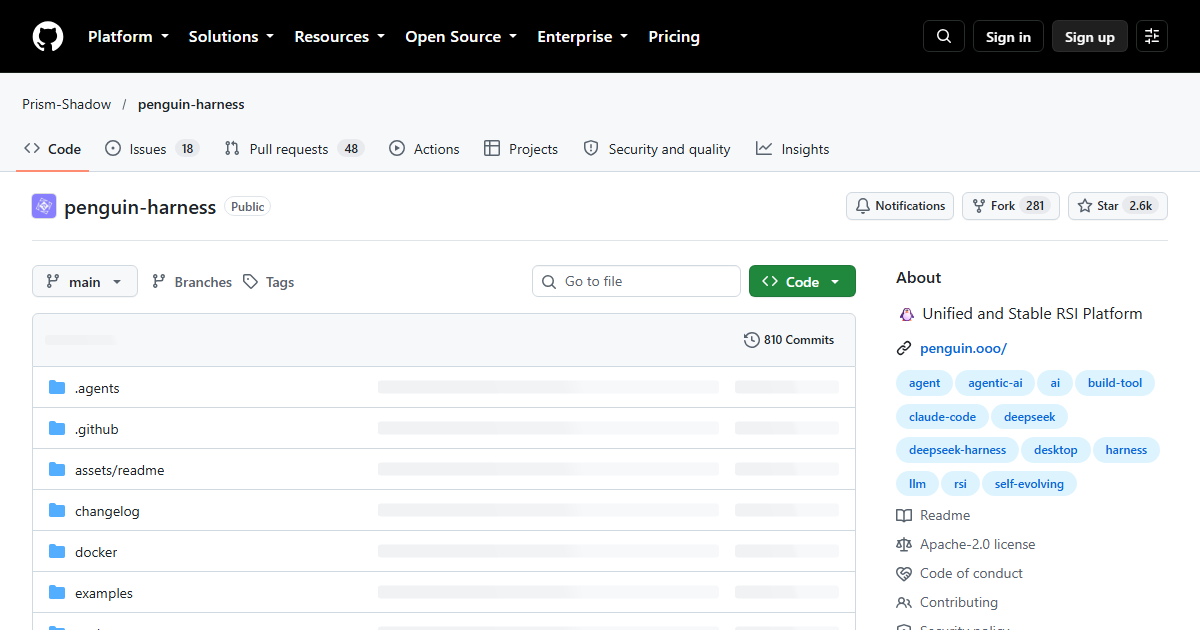
One-liner: PenguinHarness is an open-source multi-agent auto-development platform whose tagline is “Let AI Build AI” — agents build and manage other agents under a harness designed for transparency.
Verified facts (checked 2026-09-22)
| Attribute | Value | Source |
|---|---|---|
| GitHub stars | 2,328 (249 forks) | Prism-Shadow/penguin-harness via GitHub API, 2026-09-22 |
| License | Apache-2.0 | GitHub API, 2026-09-22 |
| Repository created | 2026-07-19 | GitHub API |
| Last push | 2026-09-21 (one day before check) | GitHub API |
| Open issues | 90 | GitHub API |
| Owner | Prism Shadow | repository metadata |
What it actually does
The project describes itself as a “harness for RSI” with an “Everything is Transparent” principle. In practice that means a multi-agent platform aimed at automated software development, where agent construction, orchestration and decision flows are meant to be inspectable rather than hidden inside a monolithic loop. The README ships quick-start instructions, and the repository is being pushed to almost daily at check time, so the feature surface is moving quickly.
What the marketing doesn’t say
This is a young project — the repository was created in July 2026 — and it is small relative to the category leaders: roughly 2.3k stars with 90 open issues at check time. Claims circulating from secondary coverage about its per-task economics are not backed by verifiable primary sourcing, so this entry deliberately reports no per-task cost figures; treat the cost angle as a design direction, not a measured result. As with any early auto-dev harness, pin the exact commit you evaluate against and re-read the current README before trusting a third-party tutorial.
Who should use it
Developers researching transparent, RSI-style multi-agent development who want an Apache-2.0 base they can self-host and modify without license contamination. If you need a battle-tested framework with long-term stability guarantees, this is still an evaluate-and-track project rather than a default choice.
Repository stats and license verified against primary sources on 2026-09-22. This entry follows our verification policy: every claim here was checked against primary sources, not copied from other reviews.
Repository facts (GitHub API + raw README, checked 2026-10-16)
| Attribute | Value |
|---|---|
| Stars / forks | 2,551 / 281 |
| Open issues | 66 |
| Licence | Apache-2.0 |
| Primary language | TypeScript |
| Repository created | 2026-07-19 |
| Last push | 2026-10-16 |
| Archived | No |
| Linked homepage | penguin.ooo |
| GitHub topics | rsi, self-evolving, harness, claude-code, deepseek-harness, desktop |
Pushed the same day this was checked, four months after the repository was created — this is the activity profile of a young project being actively developed, not of an abandoned one. The Apache-2.0 licence and TypeScript codebase match what the frontmatter on this page claims.
What the README actually lays out
The tagline is “Unified and Stable RSI Framework — automatically improve model × agent harness”, and the README’s own structure tells you where the weight sits: Self-evolution, One sentence, one app, What agents can do, Results, Built-in plugins, Supported models, then install. Supported models are split into closed-source and open-source sections, so you can tell before installing whether your preferred provider is covered.
Install routes documented in the README: desktop app, CLI and server, Docker, and an
optional Chrome extension. The README carries a Node >= 24 badge and an npm badge for
@prismshadow/penguin-core, plus CI and Pages build badges — a reasonable proxy for whether the
project’s automation is running. Community links are Discord, X (@code_hiyouga), a WeChat user
group, and separate docs, blog and download pages under penguin.ooo.
Claims to verify before you trust them
The README contains a Results section and a Product Hunt badge reading “Let Agents
Autonomously Build Better Agents for $0.02”. Those are the project’s own figures: we have not
reproduced them, and the $0.02 number is a per-task cost claim whose meaning depends on the
model, harness and task you run. The same caution applies to the frontmatter cost claims already
recorded on this page — they were taken from the project’s own documentation, not from a billing
statement we can see.
The honest summary for a reader: actively pushed, permissively licensed, ambitious scope, and young enough that “it worked in the README” is the strongest evidence available as of 2026-10-16. Run it in a container or on a machine without your production credentials first, and check the open issues (66 at the last look) for anything that matches your model provider.